SPEAK WITH A REPRESENTATIVE TODAY
CALL (718) 951-7200
Proudly Serving NYC & the Tri-State Area

Don’t Get Fined This Winter: Fire Log Book Requirements for Heating Season

  • Fire log books are the first thing inspectors check and must document all required daily, weekly, monthly, semi-annual, and annual fire safety tasks.
  • Heating season raises fire risk, with boilers, generators, and heating systems running at full capacity, making accurate recordkeeping even more critical.
  • Incomplete or missing entries can result in fines, violations, lost occupancy permits, and liability during emergencies.
  • Compliance requires detail, including boiler checks, generator test runs, extinguisher inspections, smoke control system logs, and alarm records.
  • Documentation must adapt as buildings evolve, ensuring new systems and renovations are reflected in the log book.
  • Total Fire Protection support includes distribution of official fire log books, staff training, pre-inspection readiness, violation remediation, and ongoing compliance services.

When the temperatures drop in New York City, heating systems become the heartbeat of every building. Boilers, generators, and ventilation systems work overtime to keep tenants warm and operations running smoothly. Yet with this seasonal reliance comes heightened fire risk and stricter oversight from Authorities Having Jurisdiction.

For property managers, the challenge is not only maintaining the systems themselves but also ensuring that every inspection, test, and fire safety procedure is accurately documented. Fire log books serve as the official record of compliance. Without them, even a well-prepared facility can face fines, violations, or delayed approvals.

Winter fire safety is not optional. It is a season when equipment is strained, risks multiply, and recordkeeping is scrutinized. The ability to produce complete fire log books may determine whether a building remains in compliance or falls into costly penalties.

Documentation as Your First Line of Defense

Most building owners emphasize alarms, extinguishers, and sprinklers when they think of winter fire safety. But these active systems only tell part of the story. Inspectors often begin with something far simpler: the fire log book.

Daily boiler checks, monthly generator tests, extinguisher inspections, and fire safety director entries all need to be recorded in black and white. These records prove that the building has met NFPA and FDNY requirements, not just in theory, but in practice.

When entries are missing or outdated, the consequences are immediate. Inspectors issue violations, AHJs escalate enforcement, and fines follow. More importantly, a lack of documentation creates liability during an emergency. Without records, it becomes impossible to prove due diligence.

Heating Season, Heightened Risk

Winter does not just change the weather. It changes the profile of fire risk inside buildings. Boilers run at maximum capacity, generators are placed on standby for winter storms, and heating equipment introduces new ignition sources. At the same time, snow and ice can block exits, sidewalk sheds, and ventilation systems.

Inspectors know this, which is why they focus heavily on winter fire safety documentation.

They expect to see:

  • Boiler log entries confirming operational checks
  • Generator logs detailing test runs and load transfers
  • Fire extinguisher and emergency exit inspections
  • Records for smoke control systems, alarms, and standpipes

Every line in these books represents a building that has actively managed its risk. Every omission is treated as negligence.

The Real-World Cost of Incomplete Fire Log Books

In the field, Total Fire Protection frequently encounters properties that are diligent about maintenance but fall short in documentation. A generator may have been tested, or extinguishers checked, but without an entry in the log book, inspectors have no proof.

The result is the same as if the work had never been done. Citations are issued, fines accumulate, and in some cases, occupancy permits are jeopardized. During winter, when violations are most aggressively enforced, even a single missing entry can result in thousands of dollars in penalties.

More troubling is the liability exposure. If a winter fire occurs and log books cannot demonstrate compliance, insurers may deny claims and building owners may face litigation. Documentation is not just a regulatory requirement. It is a shield against financial and legal fallout.

Fire logs

What Proper Fire Log Book Compliance Entails

Compliance is not a one-size-fits-all task. Different systems require different documentation schedules, and inspectors look for detailed entries at each interval.

Fire log books must cover:

  • Daily records such as fire alarm entries, boiler checks, and fire safety director logs
  • Weekly and monthly records including generator tests, sprinkler inspections, and standpipe reviews
  • Semi-annual records for smoke detector cleaning, manual pull station tests, and alarm signal checks
  • Annual records including full component inspections, elevator tests, sensitivity testing, and safety training documentation

Each of these categories must be complete, accurate, and available on demand. Generic notes or inconsistent entries do not satisfy AHJs. What they want to see is evidence that every system has been monitored according to NFPA and FDNY standards.

Why Documentation Must Evolve with Your Facility

Log BooksBuildings are never static. Renovations introduce new penetrations, new systems require additional testing, and occupancy changes alter risk profiles. Fire log books must evolve with these changes.

For example, a facility that adds a new generator must also add new generator log entries. A building that undergoes a sprinkler upgrade must ensure all new inspection intervals are reflected in its records. Winter is often when these oversights are uncovered, as AHJs perform targeted reviews of heating-related systems.

By maintaining a dynamic approach to fire log books, property managers not only avoid fines but also ensure their records reflect the real operational state of their facility.

Total Fire Protection’s Full-Scope Support

At Total Fire Protection, we recognize that property managers cannot afford to fall behind on compliance, especially during heating season. That is why we provide comprehensive solutions that extend beyond supplying fire log books:

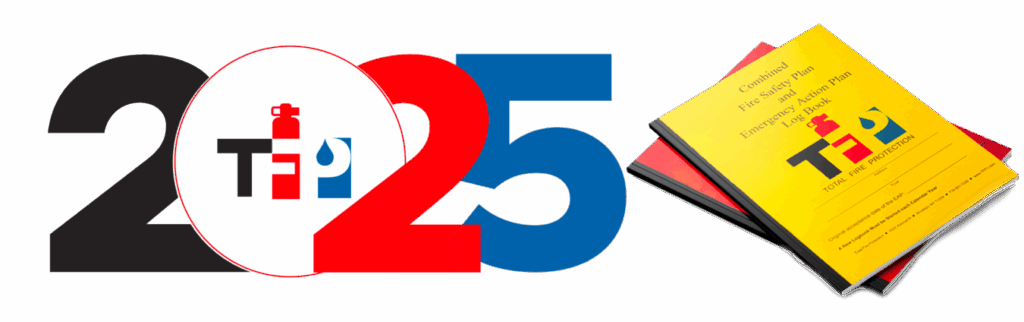
  • Distribution of all required 2025 Fire Log Books covering boilers, extinguishers, generators, standpipes, and more
  • Onsite training for building staff and Fire Safety Directors to ensure accurate recordkeeping
  • Pre-inspection readiness reviews to align documentation with AHJ expectations
  • Violation remediation when records are incomplete or fines have already been issued
  • Ongoing compliance support tailored to the seasonal needs of NYC facilities

For more than two decades, TFP has worked with hospitals, high-rise residential towers, commercial campuses, and schools across the city. Our expertise is not only in fire protection systems but in navigating the complex compliance landscape that governs them. Stay ahead of winter fire safety risks.